Problem
In Pakistan, millions of people never get the chance to learn. School is too expensive, too far away, or simply out of reach, and many leave early to work or help at home. Without skills, they stay stuck in low-income work they can’t escape.
WorkUX Design
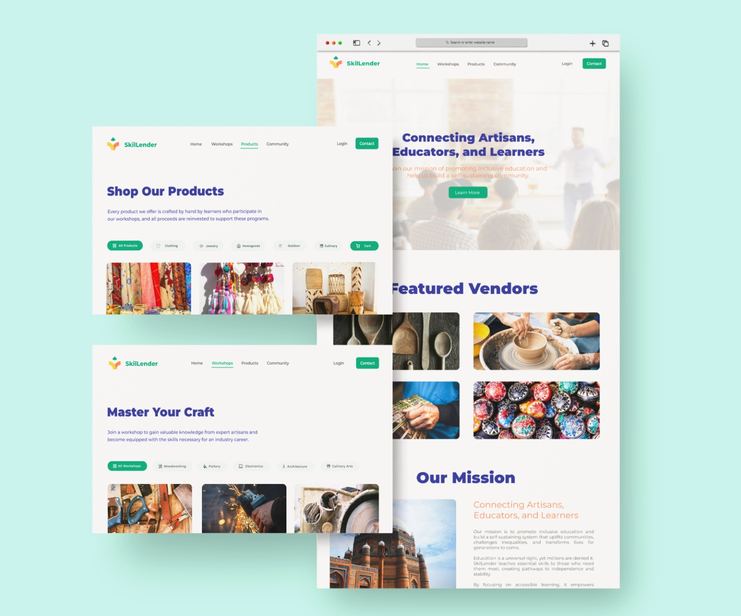
SkilLender is a skill-sharing platform that connects artisans, educators and learners in Pakistan through free hands-on workshops, then sells what students make to help fund the next class.
In Pakistan, millions of people never get the chance to learn. School is too expensive, too far away, or simply out of reach, and many leave early to work or help at home. Without skills, they stay stuck in low-income work they can’t escape.
SkilLender offers free, hands-on workshops taught by local artisans and business owners. In exchange, each student makes three quality products that are sold online and in stores, so the system pays for itself and keeps growing.
Our brief was the UN’s SDG 4: Quality Education. We focused on target 4.4, increasing the number of youth and adults with real job skills, and chose Pakistan as our case study.
We studied existing education services and community programs in Pakistan and abroad to find what works and where the gaps are. Most focus on school subjects and need devices many people can’t afford.
Works well
Peer-led, community-owned and personal. Members teach each other relevant skills.
Could improve
Irregular meetings and weak organization.
Works well
National-standard textbooks, AI teaching support and modular training.
Could improve
Teaches subjects more than skills, and needs digital access.
Works well
A digital platform that connects people in person around hands-on skills.
Could improve
The same model could work for education with a standard program.
Primary users
Underprivileged teens and adults who never went to school and want income-generating skills.
Secondary users
Artisans, craftsmen, professionals, NGOs and community service organizations.
Tertiary users
Locals who provide space, program directors, store owners in cities and customers.
We built a circular system inspired by equipment rental, sliding pay scales, fair-trade shops and the glassblowing “make one, give one” model.
Students join hands-on workshops at no cost.
Artisans and business owners teach and rent out their tools.
Each student makes three quality products to “pay” for the class.
Products sell online and in stores on a sliding pay scale.
↻ Sales and donations fund the next workshop, so the system sustains itself.
We each sketched a pamphlet, then tested one combined layout. Feedback pushed us further: a brochure alone couldn’t build a market, so we expanded SkilLender into a website that connects learners, artisans and customers.
We looked for bright but cohesive colors, subtle layering that relates to the place being served, easy-to-read icons, and clear titles with action statements.
A learner hears about SkilLender through the website, a community representative or word of mouth, learns a skill in a free workshop, makes three products, and takes the skill into a better job or their own business.
EARLY WEBSITE WIREFRAME STRUCTURE
We shared the wireframes in critique to see how clearly the workshop schedule came across.
We added a calendar with a different color for each workshop, so learners can tell sessions apart at a glance and plan ahead. The color-coded meetups appear on the Community page.
We explored several marks before landing on a simple, warm symbol that pairs the green of growth with the orange and yellow of handmade craft.
We chose warm, bright colors that feel hopeful without being childish. #0B966C stands for growth and drives every action, #FF7C4B and #FBBA4E bring the warmth of handmade craft, #313484 anchors headlines, and #F7F4F1 keeps everything soft and readable.
The reference pairs bold Montserrat headlines with a clean body face. This page keeps the site’s Montserrat typography and fluid text sizing throughout.
The brand mark, palette, type and reusable interface pieces come together as one toolkit for the platform.
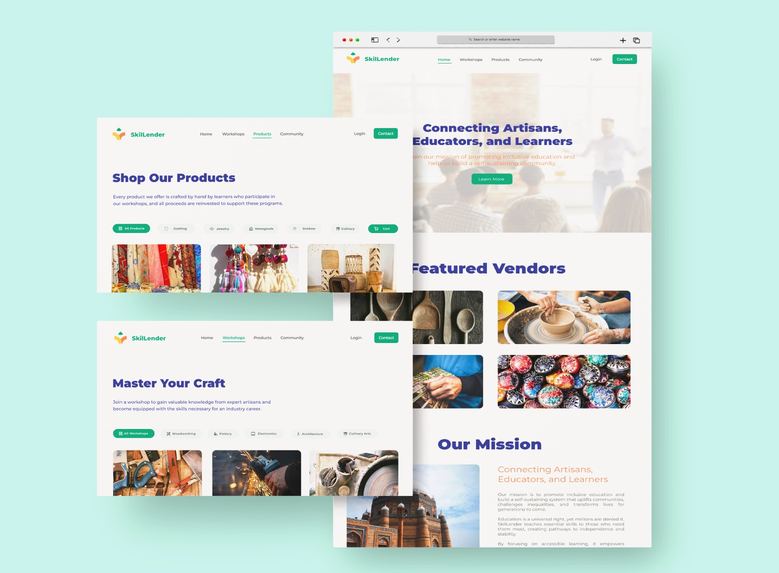
The final concept brings the learning journey, shop and community into a single connected experience.
A clear mission up front, featured vendors, and the story behind SkilLender.
Filter by craft, see who’s teaching and when, and register in one tap.
Every product is handmade by a workshop learner, with the maker’s name on each card.
Photos, specifications, price in rupees and related items from other makers.
A learning inquiry board, a form to share a skill, and color-coded meetups.
A tri-fold brochure brings SkilLender offline, where many learners can’t access the internet. It explains the SDGs, the Pakistan case study, and how students, instructors, stores and donors fit together.
Free, hands-on workshops with local makers.
Student-made products help make the next class possible.
Teach a skill, join a workshop, or support a learner.
SKILLENDER · UX DESIGN & BRANDING
Learn a skill.
Make it matter.